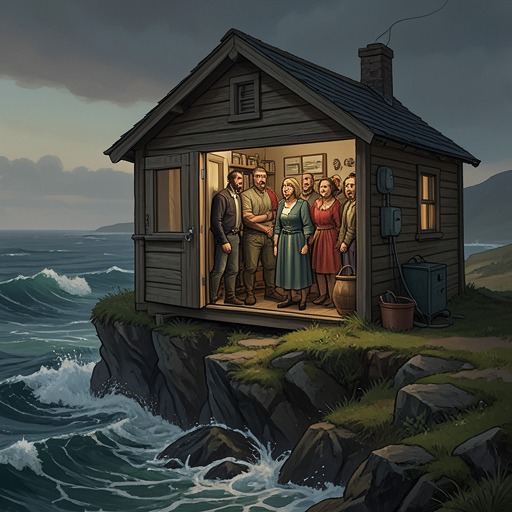
Dower House
Just DesertsDower House is the secluded refuge operated by Lady Radha Pentland and Sir David Pentland at Grenadine Reef. It receives women harmed by men, gives them protected time to recover, and helps them decide what kind of life can follow. Its importance lies not merely in sheltering victims but in creating a discreet female-centered structure that supplies safety, care, training, transport, and a route back into the world.
Foundation and Purpose
From the first year that Lady Radha and Sir David lived at Grenadine Reef, they provided the house as a refuge for women treated badly by men. Most residents came from among servants, tenants’ daughters, or tradesmen’s families. They could come to recover and, where necessary, deal with the consequences of what had happened to them. Lady Radha met new arrivals without judgment, allowing them to unburden themselves, speak angrily about injustice, or remain silent until they were ready.
The refuge arose from Lady Radha’s own history of displacement and violence. Born Radha Bhimani in Kutch, she was kidnapped when she was only a year older than Elizabeth Bennet and intended for sale into slavery. After rescue off the coast of the Arabian Peninsula, she was taken to Spain, forced into a nunnery outside Cadiz for six years, and later captured by pirates while travelling toward Cartagena. She survived a stomach wound and four days of pirate depredations before Sir David cared for her in Bridgetown on Barbados. Her experience made the refuge more than an act of conventional charity: it was a practical answer to a society that blamed or shunned women for the violence committed against them.
Space, Secrecy, and Female Administration
Dower House was kept apart from the main manor. Its location was sufficiently concealed that visitors to Grenadine Reef could be shown around the estate without being taken there, and even the Pentlands’ Scottish relatives were kept away after Lady Radha’s funeral. The house was staffed only by women and operated as a self-contained establishment. Mrs. Perkins, the Pentlands’ housekeeper, visited twice each week, while Lady Radha went whenever residents requested her presence.
Secrecy depended on both loyal staff and limited visibility. Because only Lady Radha and Sir David lived in the main house and they did not entertain, the estate required few servants: the kitchen had a cook, an assistant, and two scullery maids, while the upstairs staff was similarly reduced. The refuge itself remained outside ordinary social circulation, protected from gossip by its separation from the manor, neighboring farms, and the routines of polite visiting.
Vivian Harkness and Violet Harkness became long-term workers at Dower House after Vivian escaped her employer. Rather than return to service, the sisters worked under Mrs. Perkins and ran the house from day to day. Vivian could act as Elizabeth’s chaperone when Elizabeth met Sir David, while both sisters helped maintain the correspondence that social rules otherwise prevented between Elizabeth and the elderly baronet. Their work shows that the refuge’s survival depended on women’s administrative, protective, and communicative labor as much as on the Pentlands’ money.
Recovery and Routes to Independence
The refuge followed a recognizable process for each new resident. First came settlement and the restoration of safety. The staff then waited to see whether the woman was pregnant, after which the work shifted toward rebuilding confidence and perhaps teaching a new skill. Finally, the household helped plan the woman’s future: a return to trade or service, a move south toward London, a departure north toward the industrial cities, or emigration overseas, including to Canada.
A woman without a child generally stayed for five or six months; a woman with a child remained for at least a year. Residents were not ordinarily forced out. They retained pride and independence, understood that other women were waiting for admission, and usually chose to move on when they were ready. Sir David ensured safe passage wherever they wished to go. Even a straightforward escort toward Liverpool could make Canada a realistic destination for a woman seeking a new beginning.
The house gradually developed its own leadership. Mrs. Perkins became less involved in daily management after a former governess arrived there to escape her employer. Initially, the staff feared that the governess might impose social airs, but she proved kind, accepting, and exceptionally organized. Her promotion from resident to manager embodies the refuge’s larger method: women who have survived dependency are given the opportunity to exercise competence and authority.
Protection, Justice, and Retribution
The refuge’s protection could extend beyond recovery into covert resistance. Sir David, although publicly a naval hero and an elderly, increasingly frail man, maintained the resources and authority that made rapid intervention possible. When Elizabeth’s safety became a concern, Vivian selected additional people from Dower House, including Alison Brown, a former actress tall enough to pass as a lady, while Violet searched for another helper. The refuge could therefore provide not only shelter but discreet personnel, transport, and protective disguises.
Its most severe response involved George Wickham. Vivian Harkness had helped women secure vengeance against seven rapists, and Violet had assisted Gladys Chambers in dealing with the man who had raped her sister. Violet knocked him unconscious and pushed him down the river bank; the journey over three miles of rocks concealed the initial assault. Gladys left for a new life in Canada the following day. Sir David knew of and supported these acts of retribution, making Dower House a place where the formal protection denied to abused women could be replaced by collective action and private justice.
This system is morally darker than ordinary benevolence, but the narrative presents it as an answer to the double standard that condemned Lady Radha for surviving violence. Dower House does not require its residents to turn the other cheek when institutions and respectable society have already failed them. Its secrecy shields both vulnerable women and those who help them, while its actions expose the limits of a legal and social order built around male authority.
Continuity After the Pentlands
After Lady Radha’s death, Sir David was left alone in the large house, uncertain what to do with his life, but Dower House continued to function. Its routine was sufficiently established to operate as an institution rather than as an extension of one woman’s personal presence. Letters from Grenadine Reef continued to report its condition, and Elizabeth, who had learned estate management and the practical realities of care from Lady Radha, understood its work as part of the estate’s central responsibility rather than as an ornamental act of charity.
When Sir David died, Elizabeth insisted that the refuge continue. She planned to consult Mrs. Perkins, Vivian, Violet, and the woman then managing the house, and to preserve its funding, provisions, and transport arrangements. The house had never been visited by Elizabeth or Sir David, despite their financial support, because its independence and privacy were part of its purpose. Elizabeth described it as a refuge in the fullest sense: self-contained, invisible from the manor and nearby farms, and maintained so that women could recover without being absorbed into the household that sheltered them.
Dower House therefore survives as the most durable institutional legacy of the Pentland household. Grenadine Reef is not defined solely by land, wealth, or inheritance; its moral center is a hidden building where abused women can regain safety, acquire practical choices, and leave on terms shaped by their own futures. Through that arrangement, the novel turns domestic space into a counter-system of female protection and agency.